


AI Engineering

Specialized AI.
Measured on your task.

Develop and evaluate models for a defined responsibility, with data quality, compute requirements and deployment boundaries made explicit.

One defined task. An agreed dataset. Measurable results. View pricing

Documented AI systems

Evidence, execution
and the work around a model.

Explore the documented AI-assisted processing and operating controls in Axelyn’s existing work.

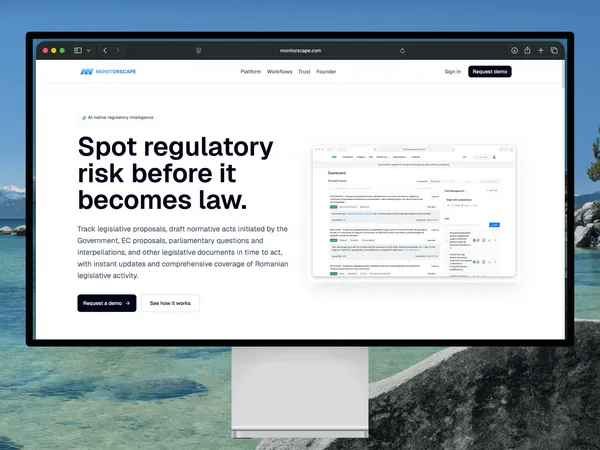
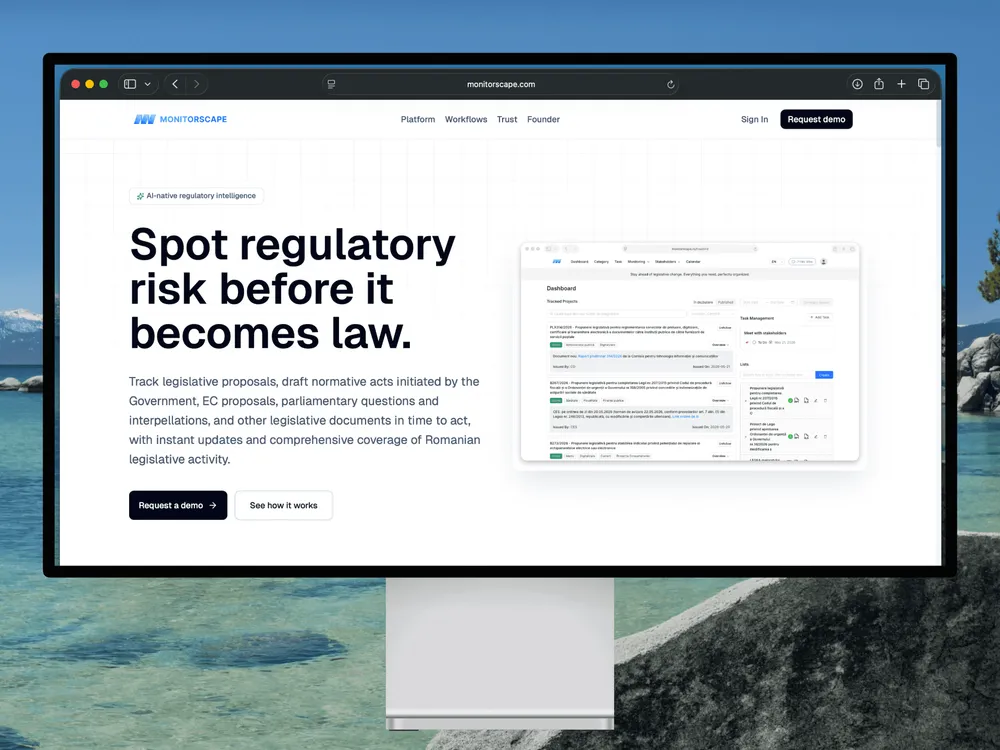
Monitorscape regulatory intelligence interface on a desktop display

Monitorscape

Analysis grounded in source material.

AI-assisted classification · Summarisation · Data pipelines

Classification and summarisation downstream of document processing and validation, with source material retained for review.

Read the case study

Our process

Define the responsibility.
Evaluate the result.

Agree on the task and baseline, inspect data and labels, run a bounded training or fine-tuning experiment, evaluate on held-out examples, and plan inference and handover. Dataset readiness, compute access and the evaluation findings determine the scope and schedule.

What the work covers

From a dataset
to an evaluated model.

Start with the decision or output the model must support. The proposal records the task, data access, experiment budget and acceptance criteria.

Data & label review
Review source access, data quality, labels and intended use. Separate training, validation and test examples, and identify gaps before training.
Prediction & classification
Develop or adapt a model for the agreed prediction or classification task, using a baseline and metrics suited to the decision.
Language-model fine-tuning
Where adaptation is justified, prepare examples and run an agreed fine-tuning experiment. Compare the result with an appropriate existing-model baseline.
Evaluation & error analysis
Measure results on held-out examples, inspect important failure cases and document the circumstances in which human review is required.
Inference & operating requirements
Agree on latency, compute, cost and data-handling constraints. Select the deployment approach that fits the evaluated task.
Reproducibility & handover
Record data versions, model configuration, experiment results and inference instructions, with operational ownership and recovery guidance.

Pricing

Scope the task.
Agree the experiment.

Model work is quoted around the task, available data, compute requirements and evaluation scope.

A defined model responsibility

Model training & fine-tuning

Prepare data and run a bounded model-development or adaptation project with measurable acceptance criteria.

Scoped quotation

Scope, experiment budget and milestones agreed in the proposal

Discuss model training

What’s included

  • Task definition and baseline
  • Dataset, label and split review
  • Agreed training or fine-tuning experiments
  • Held-out evaluation and error analysis
  • Experiment record, model artifacts and handover

The quotation specifies data use, compute costs and the experiments included. Additional datasets, repeated experiment rounds and production operations require their own scope.

An existing model and a clear task

Model evaluation & deployment

Assess an existing model against representative examples and prepare an agreed inference and operating path.

Scoped quotation

Evaluation criteria and deployment responsibilities agreed upfront

Discuss model evaluation

What’s included

  • Representative evaluation set and baseline comparison
  • Quality, latency and compute checks within scope
  • Failure cases and human review boundaries
  • Agreed inference interface and release checks
  • Configuration, monitoring and operational handover

Model retraining, new workflows, extensive data preparation and ongoing monitoring are separately scoped. Hosting, compute and third-party usage are separate costs.

Final fees and delivery dates follow the agreed task and data review. Dataset rights, permitted training use, access, retention and artifact ownership are recorded in the proposal. Compute, hosting, model/API usage and ongoing operations are separate unless explicitly included.

Before a model is handed over

Measure what matters.
Keep the limits visible.

Evaluation covers the model’s task and the conditions in which its output will be used.

Data separation
Check dataset versions, split boundaries and possible leakage between training and evaluation examples.
Baseline comparison
Compare against the agreed existing model or method using the same evaluation inputs and criteria.
Task-specific metrics
Record the metrics and error types relevant to the decision, rather than treating a training score as proof of real-world performance.
Compute & latency
Measure the agreed inference conditions and resource requirements, with enough detail to reproduce the result.
Data-handling boundaries
Check where data is processed and stored against the agreed environment, access and retention requirements.
Release & ownership
Verify inference instructions, artifact access, failure handling and the owner responsible for ongoing operation.

Before we start

Questions about
your model task.

Work directly with Amin to define the task, inspect data readiness and establish how the results will be assessed.

What model tasks can we discuss?

Prediction, classification and language-model training or fine-tuning for a defined responsibility. Start with the input, required output, available data and a practical way to evaluate the result. The data review determines the approach and scope.

Does every task need a newly trained model?

No. Establish an existing-model or conventional-method baseline first. Training or adaptation is justified by the task, evaluation results and operating requirements. A bounded experiment can help determine the useful next step.

Can the model work with private data?

The proposal identifies where data is processed, which accounts or machines are involved, who can access it and what is retained. A local or controlled deployment can be discussed where suitable. The agreed handling requirements must be checked against the selected tools and environment.

How much does it cost?

Model training, fine-tuning, evaluation and deployment receive a scoped quotation after reviewing the task and data readiness. The proposal specifies experiments, compute budget, deliverables, acceptance criteria and operational responsibilities. Hosting, compute, third-party usage and ongoing support are separate unless included explicitly.

How does this relate to automation?

AI engineering develops and evaluates the model’s responsibility. Automation and integrations coordinate the tools, data movement, validation and human handoffs around it. A project can combine both pillars within one agreed scope.